
If you’re wondering what is ETCD, it’s a distributed, reliable key-value store that is simple, secure, and fast. It plays a critical role in modern distributed systems, especially Kubernetes, by ensuring that cluster data remains consistent across all nodes. Built on the Raft consensus algorithm, it guarantees fault tolerance and high availability.
Table of Contents
What is a Key-Value Store?
Key-Value Store Explained with Example
To understand ETCD, we first need to look at what a key-value store is. It’s a database model where information is stored as key: value pairs.
Example:
- Name: Manoj
- Age: 30
- City: Kanpur
This simple model makes key-value stores extremely fast and efficient.
Difference Between Key-Value Stores and Traditional Databases
- Traditional Databases: Use structured schemas and SQL queries.
- Key-Value Stores: Are schema-free, rely on O(1) lookups, and offer faster retrievals.
This distinction explains why it, as a key-value store, is perfect for distributed environments.
Why Do We Need ETCD?
Now that we understand ETCD, let’s explore why it’s needed:
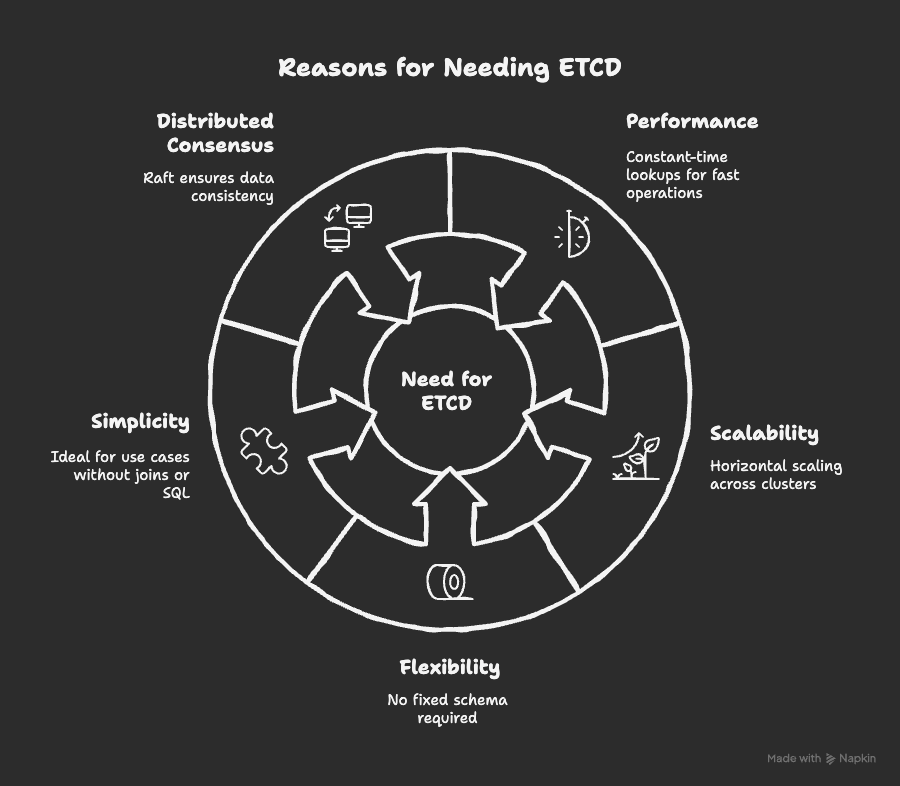
- Performance: Constant-time lookups (O(1)) for lightning-fast operations.
- Scalability: Can scale horizontally across multiple clusters.
- Flexibility: No fixed schema required.
- Simplicity: Ideal for use cases where joins or SQL queries aren’t needed.
- Distributed Consensus: Uses Raft to keep data consistent across nodes, even during failures.
Core Features
- CLI Tool (etcdctl): For direct management.
- Default Port 2379: Standard client communication port.
- Security: TLS encryption and role-based access control.
ETCD’s Role in Kubernetes and K3s
A big part of answering ETCD lies in its relationship with Kubernetes.
- In Kubernetes: It stores cluster data such as pods, services, and secrets.
- In K3s: Uses SQLite by default for simplicity, but ETCD can be enabled in HA mode as an embedded datastore.
Advantages of ETCD Over Other Data Stores
- Strong consistency guarantees
- Optimized for distributed systems
- Robust security and encryption
- Perfect fit for cloud-native environments
Common Use Cases
- Service Discovery
- Configuration Management
- Leader Election in Clusters
Limitations of ETCD
- Sensitive to network and disk latency
- Needs careful tuning for large-scale clusters
- May be complex for beginners
FAQs About ETCD
ETCD is mainly used for storing Kubernetes cluster data, service discovery, and distributed configuration.
Redis is an in-memory cache, while ETCD ensures persistence and distributed consistency.
It listens on port 2379 by default.
Yes, Kubernetes relies on ETCD as its main datastore.
Absolutely—it can be used for any distributed system requiring strong consistency.
Yes, making it flexible for evolving workloads.
[Video] What is ETCD?
Conclusion
So, It’s a fast, secure, and reliable distributed key-value store that powers Kubernetes and other distributed systems. By offering scalability, consistency, and simplicity, ETCD has become the backbone of cloud-native infrastructure. Whether you’re running Kubernetes clusters or building resilient microservices, ETCD ensures your data is always available and consistent.