
Storage is at the heart of every IT infrastructure. As data grows, organizations need flexible ways to expand capacity and performance. Two common approaches are scale-up storage and scale-out storage.
In this guide, we’ll break down what they mean, how they work, and which might be the right choice for your environment.
Table of Contents
What is Scale-Up Storage?
A scale-up storage solution adds more capacity vertically by expanding an existing system.
👉 Imagine you have a rack-mounted storage system. When you need more space, you add another drive enclosure or rack of drives to the same system.
Pros of Scale-Up Storage
- Simple to add capacity
- Cost-effective in the beginning
- Easy management since everything is in a single system
Cons of Scale-Up Storage
- Hardware bottlenecks (CPU and controllers can become overloaded)
- Limited scalability (can only add up to a certain number of racks)
- Risk of performance degradation as storage grows
In short: scale-up is like stacking storage vertically until you hit a ceiling.
What is Scale-Out Storage?
A scale-out storage solution grows horizontally by adding new storage nodes or arrays.
👉 Instead of piling more drives onto the same system, you add another storage array next to it. Each new array comes with its own CPU and resources, improving both capacity and performance.
Pros of Scale-Out Storage
- Better performance with multiple CPUs and controllers
- No stress on a single system
- Highly scalable, perfect for large and growing data needs
Cons of Scale-Out Storage
- Requires more physical space
- Can be more expensive to deploy at scale
- More complex to manage compared to scale-up
In short: scale-out is like adding more systems side by side to grow your storage.
Scale-Up vs Scale-Out: Which is Better?
- Use Scale-Up Storage if:
- You want a simple, cost-friendly solution
- You have predictable and limited growth needs
- You don’t need extreme performance scaling
- Use Scale-Out Storage if:
- Your data is growing rapidly
- You need high performance and redundancy
- You want long-term flexibility and scalability
FAQs About Scale-Up and Scale-Out Storage
Yes, many organizations start with scale-up storage for simplicity, then move to scale-out when their workloads and data requirements grow.
Not necessarily. Scale-out is more scalable but also costlier and more complex. Scale-up works great for small to medium workloads.
Industries with massive data growth like cloud providers, media companies, and research organizations typically use scale-out storage.
Yes, because all I/O operations are controlled by a limited number of CPUs, performance may drop as storage grows.
Conclusion
Both scale-up and scale-out storage solutions serve important roles in IT environments:
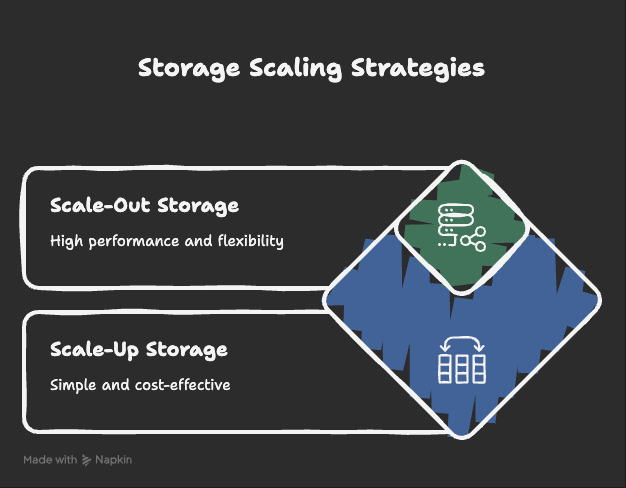
- Scale-Up Storage is simple, cost-effective, and easy to manage but has scalability limits.
- Scale-Out Storage offers greater performance and flexibility but requires more space and investment.
👉 If you’re just starting small, scale-up might be enough. But for long-term growth and high performance, scale-out storage is the smarter choice.