
If you’ve worked with Docker and Kubernetes, you’ve already seen the power of containers. But how do we manage them at scale? That’s where container orchestration comes in. In this article, you’ll find container orchestration explained in plain language—what it is, how it works, and why it’s so important for running modern applications.
Table of Contents
What Is a Container?
A container is a lightweight, portable unit that bundles an application with its required libraries. Think of it as a compact package of software that doesn’t include the operating system kernel—it relies on the host OS kernel.
Containers are widely used to run microservices and enterprise applications. But when many containers are deployed across multiple environments, manual management becomes difficult. That’s why orchestration platforms like Kubernetes are needed.
Understanding Container Orchestration
In simple terms, container orchestration is the automated management of containers. Instead of manually scaling apps up or down, an orchestration system ensures that containers adjust according to demand.
For example:
- On normal days, an app may run on just two containers.
- During peak traffic (like a sales season), the platform automatically deploys more containers to handle the load.
- Once the demand decreases, it scales back to the usual size.
This process keeps applications efficient, cost-effective, and resilient.
How Does Container Orchestration Work?
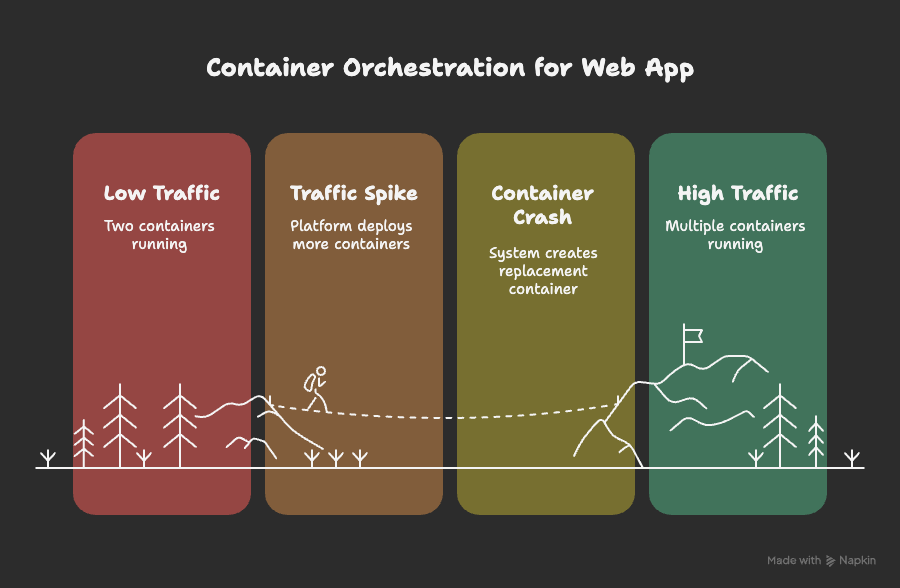
Imagine you have a cluster of 8 nodes running an e-commerce website:
- Regular traffic: Only 2 containers are active.
- High demand: The orchestration system adds new containers to balance the load.
- Crash recovery: If a container fails, another one is created instantly, ensuring zero downtime.
This automation is the backbone of today’s cloud-native applications.
Advantages of Container Orchestration
Using container orchestration provides several key benefits:
- ✅ Multi-node management – Run applications across multiple servers easily.
- ✅ Optimized resources – Save on computing costs with efficient scaling.
- ✅ Automated scaling & updates – No need for manual intervention.
- ✅ On-demand flexibility – Scale apps up or down instantly.
- ✅ Self-healing systems – Replace failed containers automatically.
FAQs About Container Orchestration
It removes the complexity of managing multiple containers by automating deployment, scaling, and monitoring.
No—while enterprises benefit most, even small projects can use it for reliability and scalability.
Popular tools include Kubernetes, Docker Swarm, and Apache Mesos.
Yes, it ensures apps remain available by automatically replacing failed containers.
Absolutely—cloud providers like AWS, Google Cloud, and Azure offer managed Kubernetes services.
Kubernetes is the most popular choice, but there are alternatives like Docker Swarm for simpler setups.
Conclusion
It simply: it’s the technology that keeps apps running smoothly by automating scaling, updates, and recovery. Whether for startups or enterprises, it ensures efficiency, resilience, and flexibility in a fast-changing digital environment.